Product Configuration AI-System
In development
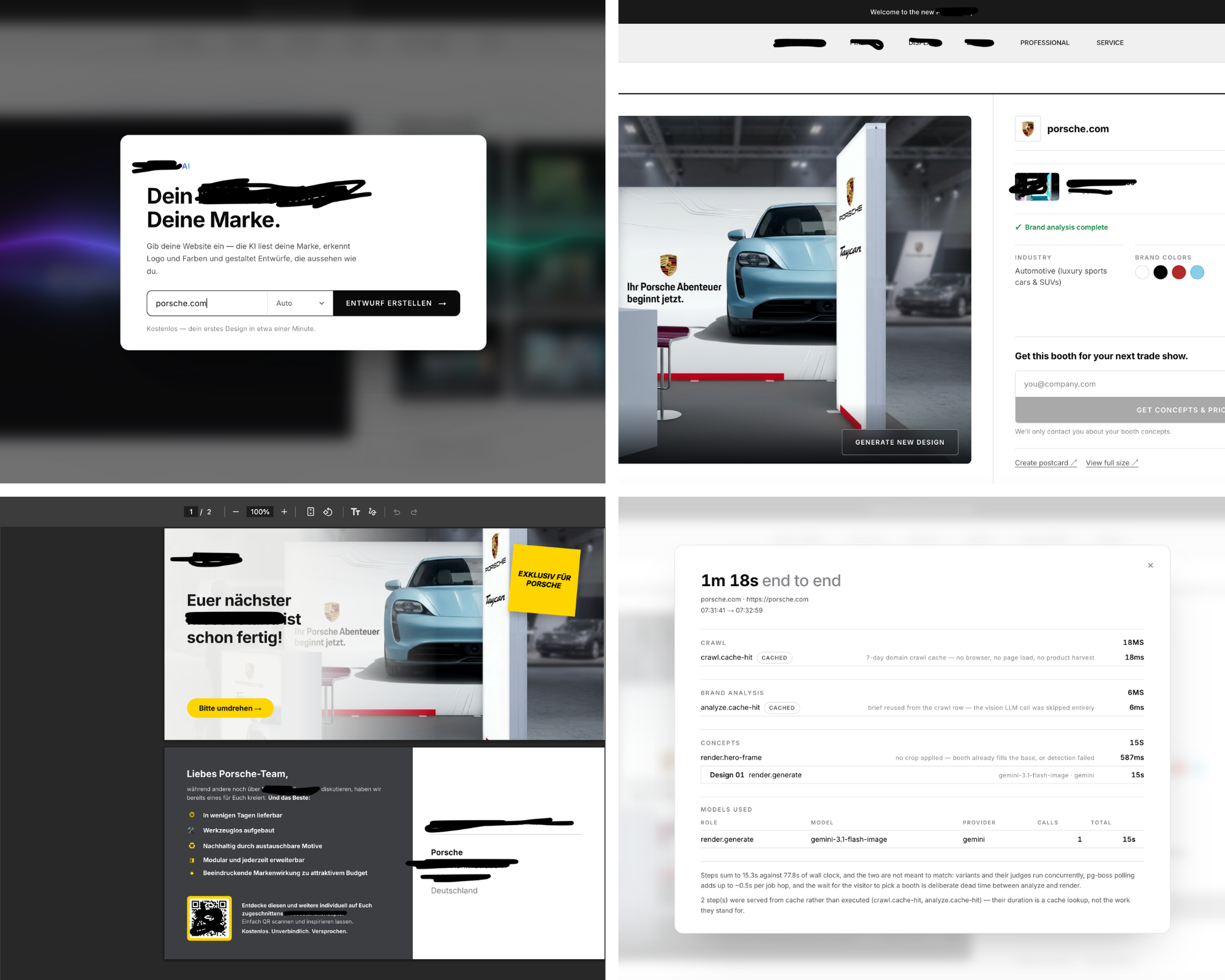
Overview
An internal rebuild of an externally developed configurator as a maintainable TypeScript-first product with explicit application, service and integration boundaries.
Problem
A product configurator that combines external analysis, generated visuals and commercial workflows needs bounded AI behavior, background processing and reliable integration boundaries.
Context
The system remains in development. This case study focuses on the verified architecture and implementation scope without exposing the company or product name.
My role
I analysed the existing product and user journeys, helped define the replacement architecture and developed full-stack application and integration work across the new product flow.
Solution
The design separates website and brand analysis, visual generation, quality checks, lead capture, document output and commerce integration. Long-running operations use background jobs with bounded retries and provider-fallback considerations.
Architecture
- Next.js product and interaction layer
- Fastify application services
- PostgreSQL data model
- Background jobs for long-running analysis and generation
- Website and brand-analysis pipeline
- AI-assisted visualization and quality checks
- Lead capture, document output and commerce integration boundaries
Technologies
- Next.js
- Fastify
- PostgreSQL
- AI analysis
- Image generation
- Background jobs
- Playwright
- AWS
- Shopify integration planning
AI components
- Website and brand analysis
- AI-assisted visual generation
- Quality-check stages
- Provider-fallback and bounded-retry design
Engineering decisions
- Make TypeScript the primary product language across the application and service layers.
- Move long-running AI work into background jobs.
- Bound retries and provider fallbacks instead of allowing unbounded generation loops.
- Keep integration boundaries explicit so the product remains internally maintainable.
What is implemented
- Multi-application TypeScript prototype
- Website and brand-analysis flow
- AI-assisted visualization and quality-check stages
- Lead capture and document-output flows
- PostgreSQL persistence and background-job architecture
What is still in development or planned
- Production hardening
- Commerce integrations
- Multi-region and cloud-operation requirements
Current status
In development
Outcome
Establishes an internally controllable architecture for reliable further development while clearly retaining its in-development status.
Evidence and confidentiality
The system is in development; customer, company and commercially sensitive details are intentionally excluded.